
PE and Sport
At Pear Tree Mead we deliver a broad and balanced Physical Education (PE) curriculum which aims to develop pupils’ physical competence and confidence and their ability to use these to perform in a range of activities. It contributes to their overall development by helping them to lead full, active and healthy lives.
PE Sessions
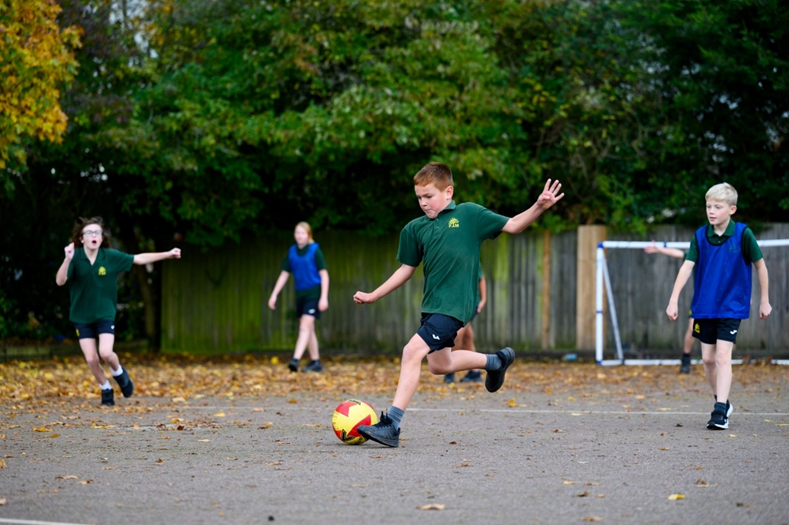
Children in Key Stage 1 and 2 take part in two hours of physical education each week. Every child receives at least one hour of formal PE lessons led by their class teacher. The second hour is made up through a combination of swimming, the Daily Mile, and OPAL (Outdoor Play and Learning) activities.
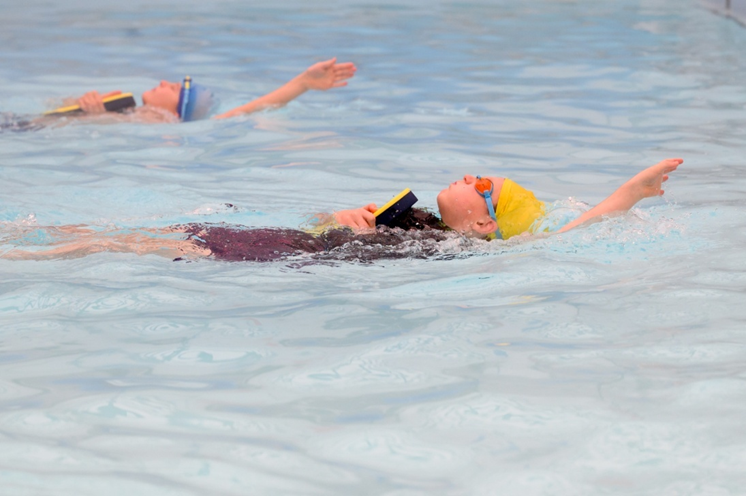
Throughout the year, children experience various strands of PE (see below), ensuring a broad and balanced curriculum. Pupils in Years 1 to 5 will enjoy a 30-minute swimming session each week in our school pool for two terms. Each class has dedicated access to both indoor hall space and outdoor areas (playground or field) to support a wide range of physical activities.
Swimming
Swimming is an essential life skill that needs to be learnt by all children in order for them to stay safe. Therefore, every child must swim every week (years 1-5). In the past, we have had children regularly ‘opt out’ for minor reasons, when the ability to swim and the understanding of water safety can and does save lives. So, it is vital that all children take part. Pear Tree Mead are proud that we can offer this experience which ensures that every child can benefit from developing confidence and key water safety skills.
The curriculum
The Physical Education Curriculum includes six strands:
+Games (tag rugby, hockey, football, basketball, netball, tennis, cricket)
+Gymnastics
+Athletics
+Dance
+Outdoor and adventurous activities
+Swimming
Gymnastics
In gymnastics, children develop confidence and control as they explore a variety of movements such as running, jumping, climbing and balancing. They learn to link these actions into sequences that include changes in direction, level, speed, and rhythm — both on the floor and using apparatus.
Pupils are encouraged to remember, select, and refine sequences through practice and rehearsal, improving their performance over time. They also learn how to safely share and set up equipment, promoting teamwork and responsibility.
Dance
Children are encouraged to respond creatively to a range of inspirations and themes, using movement to express moods, feelings, and ideas. They develop simple characters and stories through dance and expressive movement.
Children learn to make dances with clear beginnings, middles and ends. To adapt and refine performances when working with others.
Games
Children will experience elements of different sports which include chasing, dodging, avoiding and awareness of space and other players, team play and interaction with others.
To improve their ball skills of sending, receiving and travelling, to propel objects using the hands, the feet and bats/racquets etc.
Children will learn to develop their accuracy, speed, height, length and distance.
From year 1 children will start to learn the necessary skills that will allow them to participate in small sided games in a variety of different sports.
Outdoor & Adventurous Activity
Outdoor and Adventurous Activities Children are encouraged to explore the outdoors and discover the potential for physical activity within their school grounds while learning to use outdoor equipment safely. Through Outdoor Play and Learning (OPAL) sessions and The Daily Mile, pupils develop confidence, teamwork, and resilience while being active in fresh air.
Early Years Foundation stage (EYFS)
EYFS participate in hall games (duck, duck goose, throwing and catching scarfs, circuits) to promote basic gross motor skills. This also practices following instructions. This is accompanied by a 20 minute swimming session in the summer term. They also start to understand how to work as part of a team by playing games and using the parachute.
PE Kit
For all sporting activities, long hair must be tied back, and all jewellery, including earrings, necklaces, and watches, must be removed for safety. If a pupil forgets their kit regularly, parents will be contacted.
Outdoor
For outdoor activities, pupils should wear the correct and appropriate school PE kit. During colder weather, tracksuits or other warm clothing will be needed. Please check with the class teacher to know what days PE kits are needed in school.
Indoor (Gym & Dance)
Pupils should wear the correct school PE kit. Some indoor activities may be completed in bare feet.
Swimming
For swimming lessons, pupils are required to wear a swimming costume and a swimming hat,
Accompanied by swimming goggles if needed. Children must bring a towel. There are no spare swimming items available. Please ensure that your child has the necessary and suitable kit every week.
Competitive Tournaments
At Pear Tree Mead, we are proud to be an active member of the Harlow School Sports Partnership, giving our pupils the chance to take part in well-organised tournaments and compete against other local primary schools.
Additionally, children at Pear Tree Mead have the opportunity to participate in a fun and inclusive festivals organised by Passmores Academy, ensuring all pupils can enjoy a positive competitive experience.
Sports Day
Our annual Sports Days feature a mix of fun sporting activities and competitive races for all year groups. Field events are non-competitive, allowing children to participate for house points and enjoy themselves. Parents are warmly invited to attend and cheer on their children in a supportive and encouraging way.
Inclusion in PE
Please refer to the Pear Tree Mead Academy Inclusion Policy.
Inclusion is a statutory requirement of the National Curriculum. The school will implement the three principles of:
· Providing all children with equal opportunities to participate and gain confidence in different physical activities regardless of their ability, gender or culture/ethnic background.
· Providing flexibility within the teaching to allow for differentiation, enabling individuals to achieve their potential in all areas of PE.
· Opportunities must be created which promote an understanding and appreciation of each other’s abilities.
· Providing suitable activities for children that have specific physical disabilities that may impede their learning. Medical opinion and advice is always sought before these children participate in physical activities.
· No pupils will be excluded from any physical education programme unless advised by a medical professional.
· Lessons will provide good quality experiences that are suitably challenging for all pupils.
· Children will undertake different activities, but all will be given the same opportunity to achieve the aims through an appropriate range of activities.
· For children with limited gross motor skills, the integrity of activities will be maintained and expectations will take into account the individual needs of pupils.
· For the purposes of competitions, all children will be given the opportunity to participate in the experience.
Links between PE and other subjects
Maths
Children use maths in PE when measuring time, distance, speed, and height. They can also collect data, track scores, and explore shapes and angles through gymnastics and sports techniques.
English / Literacy
PE supports vocabulary development through key terms and instructions. Pupils can write about their performances, follow or create game instructions, and develop speaking and listening skills when giving and receiving feedback.
Science
PE helps children learn about the human body, including muscles, bones, and joints. PE can be linked to how exercise affects the heart, lungs, and energy levels. In PE, children will use different forces, such as push, pull, and gravity during movement.
PSHE
PE promotes teamwork, cooperation, and communication. Children build confidence and self-esteem by trying new activities, and learn about healthy lifestyles through exercise.
Music
Movement in PE often links to rhythm and timing. Children develop coordination and timing skills through dance.
Assessment for learning
We assess children in PE through observations during lessons. Teachers assess children by making informal judgements as they observe them during lessons. Children are given oral feedback throughout the PE lessons on how to improve. Older pupils are encouraged to make judgements about how they can improve during sessions.
Health and Safety
All teachers are responsible for safety in their own lessons and should therefore, be familiar with the procedures associated with the teaching of particular activities.
Common sense safety precautions should be observed at all times. Facilities, apparatus and equipment should be checked at the start of the lesson, e.g. that wall bars are secured properly, no mats overlapping, etc. Children should be taught to set out and use apparatus safely.
All children must participate in Physical Education unless a note or verbal message is received from a parent/ guardian. Exercise is not only good for the body but also the mind.
The school should be made aware of any disability/medical condition that could affect the child’s performance. Children should have the opportunity to highlight if they feel an activity or section of a session is going to be difficult. Alternative expectations may be given at this point. We ensure that the curriculum is accessible to all.
Asthma pumps can be kept in the classroom, readily available for use if needed. Some asthmatic pupils may need to keep their inhaler at hand during a PE lesson, and if this is the case, they should be taught to take responsibility for this, establishing good routines for their future safety.
Earrings must be removed and all jewellery taken off by children and staff before the start of the lesson. Children wearing jewellery will not be allowed to take part in any PE lesson or swimming. This will be discussed with families if preventative measures are not taken. We want to support children to take positive steps and ensure they are ready for their PE sessions without hindrance.
Ways to support your child in PE at home
Encourage your child to be active through games that develop coordination and movement, such as throwing and catching, tag, basketball, football, or racquet sports. Outdoor play on bikes, scooters, rollerblades, or at parks with climbing frames and swings also helps build strength, stamina, and coordination.
Promote a healthy, active lifestyle by walking to school, to the shops, or to friends' houses when possible, and discussing the importance of exercise and healthy eating. If your child enjoys a particular sport, encourage them to join a local club to further develop their skills.
Please ensure that your child has the correct uniform for PE and swimming lessons.