Mathematics

Mathematics at PTM
At Pear Tree Mead, we believe every child can succeed in maths. Our curriculum is designed to be accessible for all, while helping pupils develop confidence, fluency, and problem-solving skills. We want children to enjoy maths and see how it connects to real life and other subjects.
How We Teach Maths
-
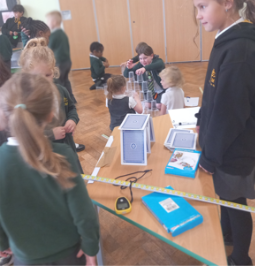
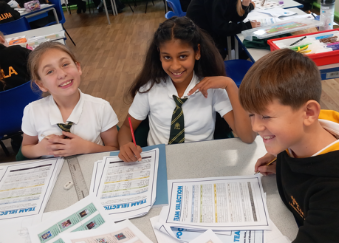
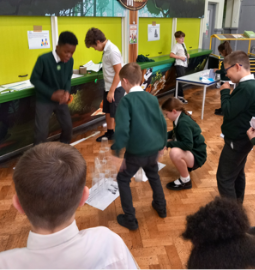
Quality First Teaching: Lessons are adapted to meet individual needs and challenge all abilities.
-
Small Steps Approach: Each lesson builds gradually, with clear explanations and plenty of practice.
-
Fluency, Reasoning & Problem-Solving: Children learn to calculate accurately, explain their thinking, and tackle challenges.
Curriculum Overview
-
EYFS: Focus on number sense using White Rose Maths
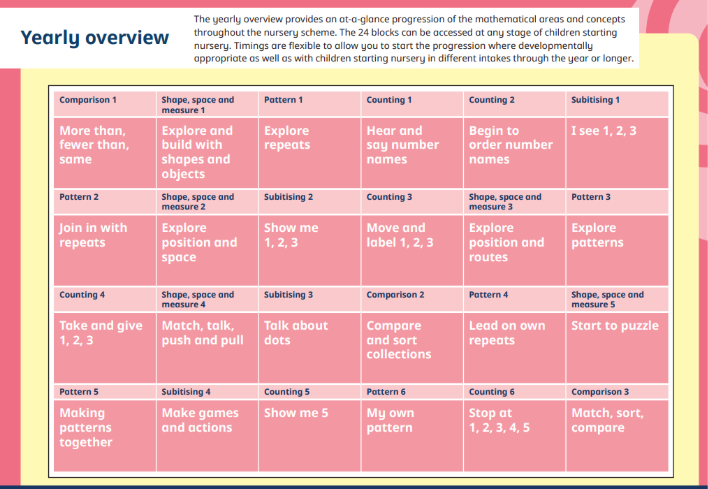
Pre-School: Numbers 0–3
Nursery: Numbers to 5
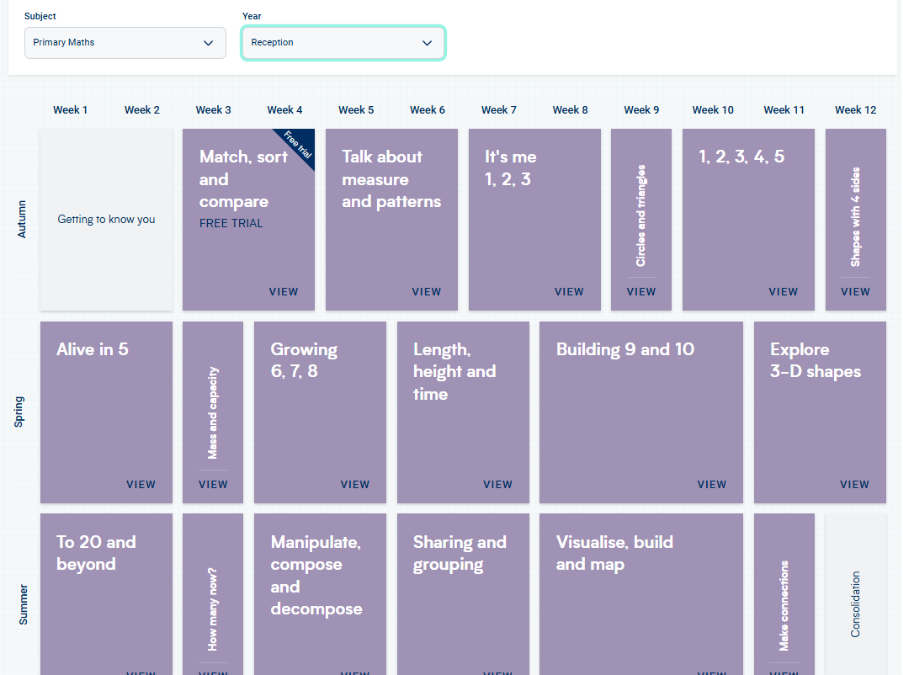
Reception: Number bonds to 10, counting to 20, shapes
-
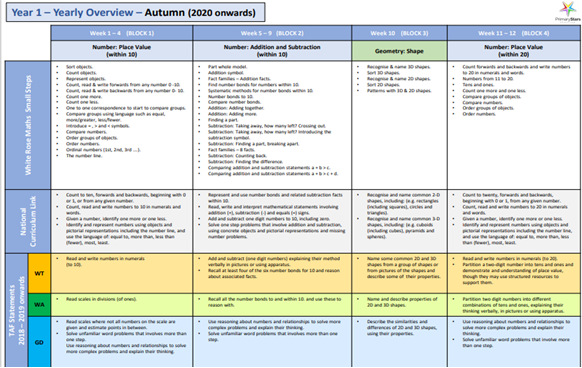
KS1: Primary Stars and White Rose for engaging, structured learning
-
KS2: White Rose Maths builds on prior knowledge and deepens understanding
Lesson Structure
-
Flashback – Quick recall of previous learning
-
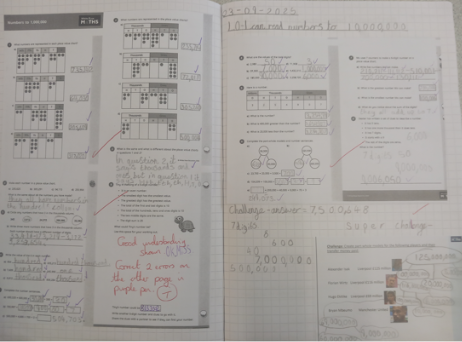
Main Learning – Teacher models, pupils practise, then apply reasoning and problem-solving
-
Challenge Tasks – For pupils ready to go further
-
Plenary – Review and consolidate learning
Our Pedagogical Principles
We use evidence-based approaches to make learning stick:
-
Retrieval Practice – Quick reviews of past learning to build long-term memory
-
Spaced Practice – Revisiting topics after a few weeks to strengthen recall
-
Explicit Instruction – Teachers model new learning clearly for secure understanding
-
Metacognition – Pupils explain their thinking to deepen reasoning and independence
-
Small Steps Teaching – Breaking lessons into sequenced steps for mastery and confidence
Key Skills
Multiplication Skills:
Multiplication skills (Yr. 2–Yr. 6) are practised daily in preparation for the weekly test. Teachers record the results of each pupil and rewards are given to those who are successful.
Weekly homework is set on Times Tables Rock Stars, which is then used to monitor the pupil’s weaker times tables in the form of ‘heatmaps’. These are shared half-termly with pupils and parents alike from Year 3 Spring term – Year 6. When pupils’ can recall all their tables under 4 seconds, their heatmaps will turn completely green. Pupils are rewarded when this happens and their names are added to the celebration wall in the large hall.
In Years 5 and 6, pupils learn how to recall squared and cubed number facts and the timestables from 13x upwards, having completed the MTC in Year 4, so as not to impede further mathematical development.
Arithmetic and Fluency Skills:
Arithmetic skills are taught regularly in Years 1 to 6 to develop fluency, and these skills are assessed weekly. Each week focusses on a particular skill/ objective pertaining to each year group.
Assessment
-
Weekly timetables and arithmetic checks
-
End-of-unit assessments to identify gaps
-
Termly NFER tests (Years 1, 3–5)
-
SATs practice for Years 2 and 6
How Parents Can Help
-
Encourage positive attitudes towards maths
-
Use everyday opportunities (shopping, cooking, measuring)
-
Explore free websites:
EYFS–KS2: Snappy Maths, BBC Bitesize, Oxford Owl, TopMarks
KS1–KS2: Times Tables Rock Stars, Primary Homework Help
KS2: Mad4Maths, CrickWeb
The Curriculum:
EYFS
-
Number
-
Developing counting skills (verbal counting, one-to-one correspondence, stable order, cardinality).
-
Understanding numbers to 10 in depth — including composition (part–whole relationships).
-
Exploring subitising (recognising quantities without counting).
-
Building comparison skills (more than, fewer than, equal to).
-
Early addition and subtraction through practical activities and stories.
-
-
Shape, Space and Measure (Spatial Reasoning)
-
Exploring 2D and 3D shapes — naming, describing, and comparing.
-
Understanding position, direction, and movement.
-
Developing pattern awareness and the ability to extend and create patterns.
-
Comparing and measuring length, height, weight, and capacity in everyday contexts.
-
Mathematical Thinking and Talk
-
Encouraging children to reason, explain, and use mathematical language.
-
Supporting children to spot connections and solve problems in real-life play situations.

Structure
-
The curriculum is organised into small steps across the year, often following termly units such as:
-
Autumn: Just Like Me! / It’s Me 1, 2, 3! / Light and Dark
-
Spring: Alive in 5! / Growing 6, 7, 8 / Building 9 & 10
-
Summer: To 20 and Beyond / First, Then, Now / Find My Pattern / On the Move
Each unit blends practical exploration, visual representations, and storytelling.
Nursery
Reception
KS1- Primary Stars Overview:
Year 1 Autumn Term
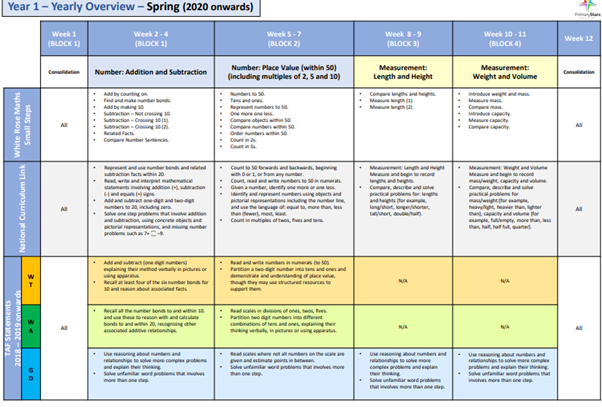
Year 1- Spring Term
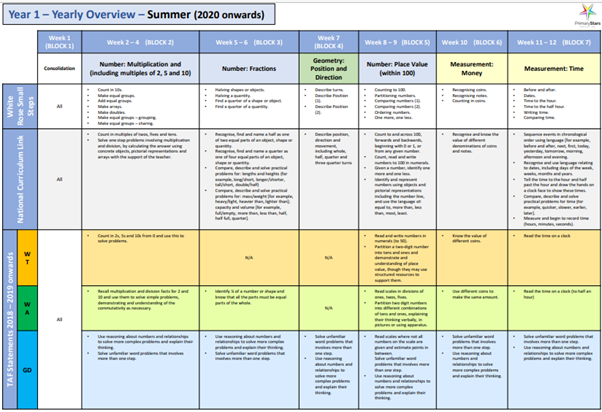
Year 1 Summer term
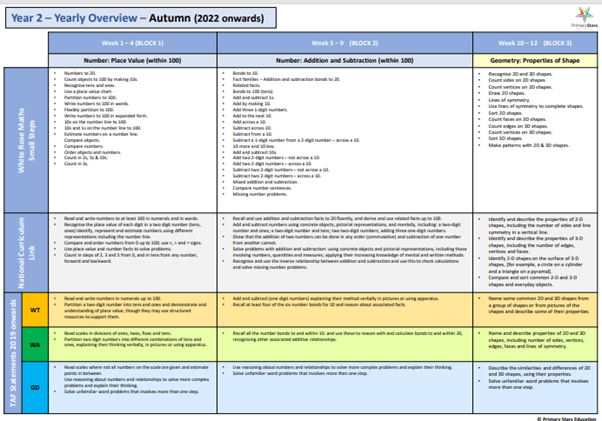
Year 2 Autumn Term
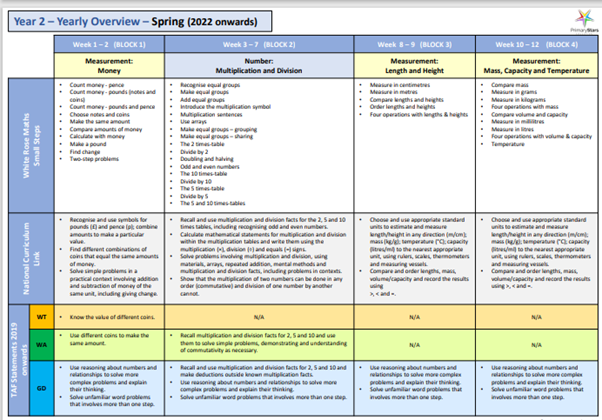
Year 2- Spring Term
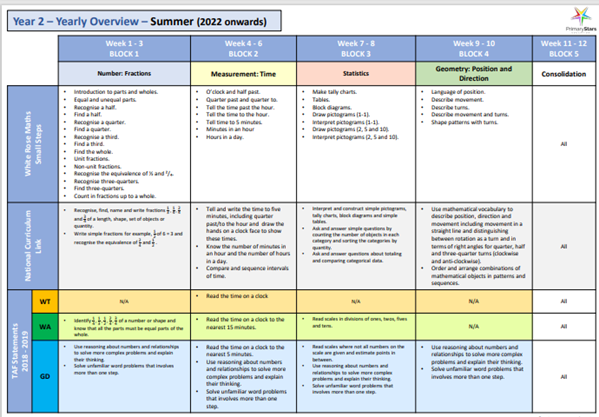
Year 2- Summer Term
KS2- White Rose Overview:
Main Areas of Learning
-
Number and Place Value
-
Understanding the value of digits in increasingly large numbers (up to 10 million by Year 6).
-
Reading, writing, comparing, and rounding numbers.
-
Working with negative numbers and Roman numerals.
-
Addition, Subtraction, Multiplication and Division
-
Developing efficient written and mental strategies.
-
Understanding the relationship between operations.
-
Multiplying and dividing by 10, 100, and 1,000.
-
Using estimation and inverse operations to check answers.
-
Fractions, Decimals and Percentages (FDP)
-
Recognising and comparing fractions; finding equivalents.
-
Adding, subtracting, multiplying and dividing fractions.
-
Understanding decimal place value and converting between fractions, decimals, and percentages.
-
Ratio, Proportion and Algebra (mainly Years 5–6)
-
Understanding and solving problems involving scaling and proportion.
-
Using simple formulae and finding unknowns in equations.
-
Measurement
-
Converting between units of length, mass, capacity, and time.
-
Calculating perimeter, area, and volume.
-
Working with money and solving problems involving measures.
-
Geometry
-
Recognising and classifying 2D and 3D shapes.
-
Understanding angles, symmetry, and properties of shapes.
-
Describing position, direction, and movement using coordinates.
-
Statistics
-
Interpreting and constructing tables, charts, and graphs (including line graphs).
-
Calculating and interpreting averages (mean, mode, median, range).
Approach
-
Concepts are taught in small, connected steps with visual representations (such as bar models, place value grids, and arrays).
-
Regular reasoning and problem-solving tasks develop deeper conceptual understanding.
-
Each year’s curriculum builds on previous knowledge in a spiral progression from Year 3 to Year 6.